Effective compliance and risk management is critical. If poorly managed, it can impact workplace health and safety, disrupt operational efficiency, damage your brand's reputation, or put your company at risk of serious financial and legal implications.
A big part of strong compliance and risk management is company culture, and an appetite to do this in the best way possible for everyone’s benefit. How you can manage this however is not always as straight forward. Core to effective management is not just having the right culture, but the best understanding and tools in place to put process into action.
This is true across all industries, whether it be manufacturing, hospitality, finance, retail; the list goes on!
One question we should all ask ourselves: “How much could one missed compliance check really cost our business?”
What Is Compliance and Risk Management?
While the related day-to-day responsibilities may differ between roles within an organization, compliance and risk management are both critical in their business's importance and impact.
Compliance management is the process of ensuring that an organization adheres to the ethical, regulatory, and legal requirements of their industry. In comparison, risk management involves identifying and assessing dangers or threats that may occur within an organisation. Policies and procedures are then developed to mitigate risks, and strategies are implemented so that if a problem does arise, the impact is minimal or zero.
Strong compliance management naturally strengthens your overall risk strategy. Risk and compliance management are similar in that they need to be constantly monitored and reviewed to assess effectiveness and ensure they continually evolve with the changing landscape.
Importance to Safety and Operations
Protection is at the heart of risk and compliance management. The processes and strategies put in place ensure that your people are safe and free from harm, that you do not have a negative impact on your environment and that your business remains operational.
Legal, financial, and reputational damage is a reality if repeated dangers and non-compliances occur within your organization due to poor management. Moreover, it can damage your brand's reputation and impact your ability to be competitive within your industry.
Beyond this, however, strong compliance and risk management create a culture of proactive oversight, instead of reactive “band aid” fixes. It seamlessly integrates into everyday actions visibility and accountability. This visibility deepens understanding of issues and root causes for improved decision making and gives an accurate representation of performance.
As previously mentioned, compliance and risk management share is that they need to be continually reviewed and updated. With better oversight, action can be taken earlier as you know exactly where problems exist and why.
Common Challenges
How information is collected and shared can be a common challenge when managing compliance and risk. Recording data manually or the use of separate, siloed systems can often lead to data visibility gaps, limiting oversight for managers. This can make it incredibly difficult to properly monitor processes, stay updated, or make timely, informed decisions.
Below are some of the day-to-day challenges that can be faced.
- Difficult to roll out and maintain safety standards: Teams may use outdated procedures because updates are not distributed consistently.
- Incident investigation and reporting accuracy issues: Critical details get missed when teams rely on paper notes or informal reporting.
- Hard to spot trends or uncover root causes: Isolated data makes it impossible to see patterns like recurring equipment failures or repeat behaviors.
- Monitoring preventative actions is slow or unclear: Managers cannot easily see which actions are overdue or whether they are reducing risk.
- Lacking up to date compliance status: Hazards, expired licenses, or overdue inspections may go unnoticed until it is too late.
- Reporting, audit, and inspection preparation is slow: Teams spend hours chasing documents, photos, or evidence scattered across email, folders, and spreadsheets.
How Technology Solves These Challenges
Accuracy, visibility, and oversight!
Modern solutions, by bringing together and digitizing your information, integrating historical data, and connecting with other platforms, enable access to a single, centralized view. A complete, no gap understanding of risk and compliance for your business. This changes the game for operational oversight as you can see immediately, and in real time, the critical areas or requirements that can impact performance. Through powerful dashboards and insights, you can see, for example:
- Overdue compliance requirements: Licenses, insurance, training, or inspections, etc.
- Escalating risks
- Identify trends
- The root cause of an issue
This enables you to understand not just what is happening, but why. Taking your operations from a reactive to a proactive one. It also directly feeds your ability to take corrective action, swiftly. Dashboards allow you to go a step further and measure how your organization is performing when it comes to managing risk and compliance. For example:
- What corrective actions are outstanding?
- What has been the long-term impact of our risk mitigation strategies?
Moreover, dashboards aligned to workflows allow you to track issues right from the moment of identification so that you can see who an issue assigned to or how quickly problems are addressed and closed. Not only does this provide stronger oversight, but it facilitates improved accountability for everyone across an organization.
Modern solutions also improve reporting accuracy, for teams to collaborate within the one platform, and there is an easy to monitor evidence trail for audits. Sharing audit outcomes is seamless, reducing the chances of corrective actions being missed.
Steps to Improve Compliance and Risk Oversight
Step 1: Visibility - Centralize your compliance data to build a complete and connected picture
Being able to see the full picture is integral to improving oversight. You cannot do this if your information is locked in manual records or siloed systems. All data, from historical audit records, incident information, to compliance actions will need to be integrated into one centralized platform. This way, a complete story can be created.
Step 2: Standardize - Use consistent templates and workflows to ensure data accuracy and comparability
Data collection must be consistent for an accurate story to evolve. When compliance or risk information is captured and reported in a standardized way, the dots can be connected quicker by the platform. This ensures that critical information is not misrepresented, and trends can be spotted before escalating into major problems.
Step 3: Accountability - Empower teams through transparent reporting and clear ownership of actions
Transparent access to performance and audit reports is crucial in helping to establish a thorough understanding of “what” is happening within an organization. The critical next step, however, is to outline “who” is responsible for subsequent outcomes. By clearly assigning follow up actions to an owner and deadline, it reinforces individual responsibility, ensuring that the next steps are not just documented but closed out. This makes sure that goals of “continuous improvement” do not become passive and are instead held to account by outlined obligations and timelines.
Proven Real World Impact
A successful compliance and risk management framework requires visibility, effective and efficient audits, and a reliable reporting process that spans different regions, sites, and teams.
Explore our Energy Safe Victoria and Sequana case studies to learn how SafetyInsights has been utilised to enhance audit readiness and outcomes, strengthen risk oversight and operational visibility, and significantly reduce workload.
Energy Safe Victoria Case Study | SafetyInsights
How Energy Safe Victoria realised transformative improvements in their safety audit processes and regulatory compliance reporting.

Sequana Case Study | SafetyInsights
By digitising governance processes during a complex merger, Sequana reduced reporting time by 50%, improved data accuracy by 60%, and enabled real-time stakeholder insight - driving faster, more confident decision making.

Ready to transform compliance and risk management for your business operations? Let's connect and explore how a centralized, data-backed approach empowers organizations to achieve full compliance visibility.
Compliance Management: A Comprehensive Guide | SafetyCulture
Learn everything about compliance management, its importance, elements, and vital strategies to ensure regulatory success.

The Importance of Risk Management | SafetyCulture
Learn what risk management is, its importance, and its principles. Discover how risk management helps organizations succeed with this guide.

Risk Management vs. Compliance Management: Understanding the Distinction
In the realm of organizational governance, there is often confusion between risk management and compliance management. While both functions are integral to the overall health and sustainability of an organization, and part of GRC, they are fundamentally different in their purpose, approach, and exec

Audits / Inspections | SafetyInsights
Gain audit insights with SafetyInsights. Use your SafetyCulture data to spot issues, track safety inspection performance, and monitor corrective actions.
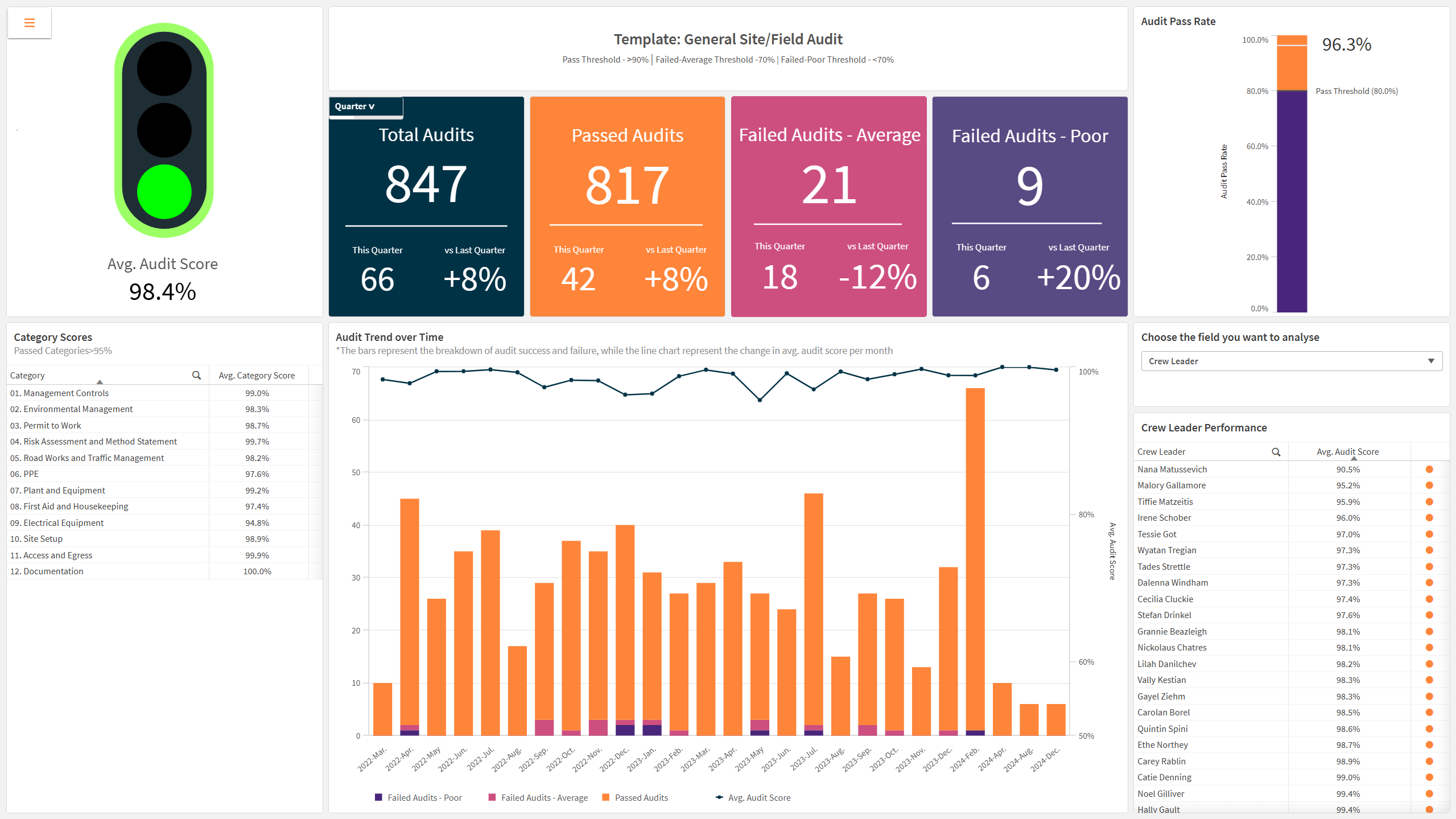
Audits / Inspections | SafetyInsights
Gain audit insights with SafetyInsights. Use your SafetyCulture data to spot issues, track safety inspection performance, and monitor corrective actions.
Audits / Inspections | SafetyInsights
Gain audit insights with SafetyInsights. Use your SafetyCulture data to spot issues, track safety inspection performance, and monitor corrective actions.