In any workplace, especially in high-risk or high-standard industries like construction, manufacturing, or luxury retail, maintaining baseline workplace safety standards and compliance is just the beginning. But staying compliant doesn't always mean you are performing at your best.
While audits are traditionally seen as a "pass or fail" exercise, the most successful organizations look beyond the binary of Compliant vs. Non-Compliant. They look for Opportunities for Improvement (OFIs). These are the subtle insights that bridge the gap between "meeting the standard" and "achieving excellence."
What is an Opportunity for Improvement (OFI)?
An OFI is a notation made during an audit or inspection where a specific item or process has technically met the requirements (it’s a "Pass"), but there is a clear way to make it better, safer, or more efficient.
In a standard audit:
- Compliant (Pass): The requirement is met.
- Non-Compliant (Fail): The requirement is not met and requires corrective action.
- OFI: The requirement is met, but the auditor identifies a potential risk or an area for optimization.
The Coffee Machine example: Imagine auditing a premium automotive showroom. The auditor checks the customer lounge.
- The Requirement: "Functional refreshment facilities available for clients."
- The Reality: There is a basic pod coffee machine that works.
- The Result: Compliant.
* The OFI: Because this is a high-end car showroom, a basic machine may not "delight" the customer or match the brand's prestige. The auditor marks it as "Compliant" but adds an OFI: "Assess and develop a business case for a premium, barista-style coffee station to align with brand standards."
Why OFIs Matter
- Proactive risk management: Often, today’s OFI is tomorrow’s non-compliance. Identifying a trend early allows you to fix a slide in standards before it results in a "Fail."
- Continuous improvement: OFIs foster an organisational culture of continuous improvement where "good enough" isn't the finish line. It encourages teams to think about best practices rather than just minimum requirements.
- Standardizing excellence: By tracking OFIs across multiple sites, a business can see where one team is innovating and roll those "improvements" out to the rest of the organization.
- Operational insights: They provide context that a simple Pass/Fail score cannot. They tell the story of the audit, showing where the business is technically compliant but operationally lagging.
How to Track OFIs in SafetyCulture
To turn these insights into action, you need a way to categorize and report on them. Many of our clients use Tagging in SafetyCulture to differentiate between a standard "Pass" and a "Pass with an OFI."
Using Tags for Visibility: When an auditor identifies an OFI, they can complete the inspection item as "Compliant" but apply a specific "OFI" Tag to the associated Action.
By tagging these items, you can:
- Filter Dashboards: Instantly see how many OFIs were raised versus actual non-compliances.
- Assign Responsibility: Create an "Action" via SafetyCulture Inspections and Reports for the OFI (e.g., "Research new coffee machines") and track its progress without it affecting your overall compliance score.
- Identify Trends: Use SafetyInsights to see if certain sites are consistently hitting compliance but generating high volumes of OFIs, signalling a need for capital investment or process overhauls.
Turning Insights into Excellence
While non-compliances require urgent fixes, OFIs require strategic thinking. They represent the "low-hanging fruit" for organizational growth. When you begin to track and value these opportunities, you move your safety and quality culture from a reactive "tick-the-box" exercise to a proactive engine for improvement.
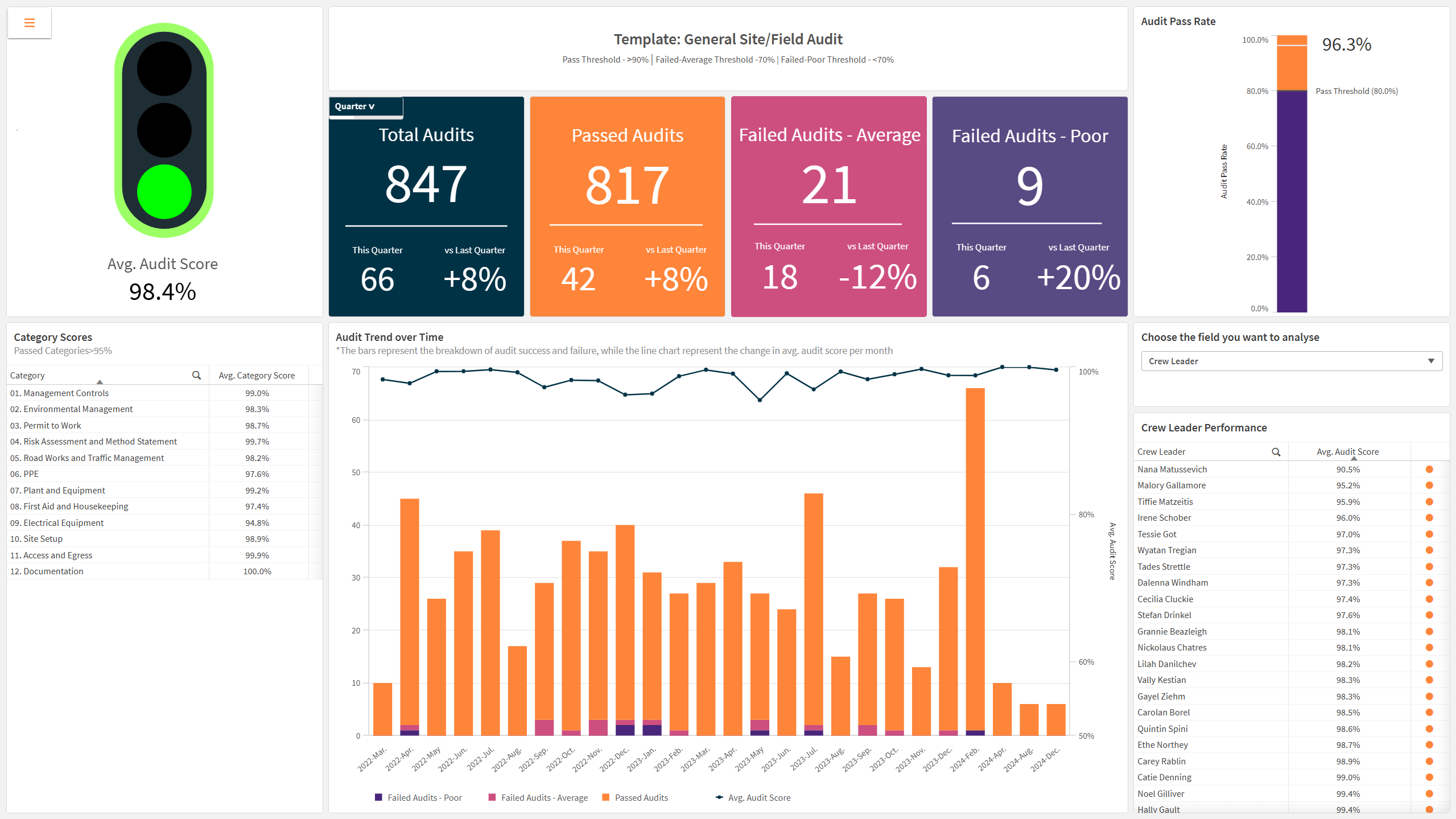
The SafetyInsights Audits & Inspections Dashboard is an indispensable tool for SafetyCulture users who want to gain a deeper understanding of their audit performance."
Capturing and Analyzing your OFIs
SafetyCulture is a powerful tool for capturing the reality of your operations, and SafetyInsights is the key to making sense of it.
If your organization is currently only looking at Pass/Fail scores, you are missing half the picture. Ensuring accurate data tagging and easy reporting is where SafetyInsights provides significant value. Our dashboards can help you visualize these OFIs alongside your standard KPIs to drive meaningful change. Some use cases include: https://safetyinsights.au/case-studies/intellihub and https://safetyinsights.au/case-studies/sequana-greater-western-water
Discover how SafetyInsights can help you unlock the power of your SafetyCulture data through advanced analytics and ready-made dashboards. Let's connect and explore how SafetyInsights applies to your business.
A Comprehensive Guide to Workplace Safety | SafetyCulture
Learn more about workplace safety, what makes a workplace safe, and how SafetyCulture can help manage and improve workplace safety.

Audits / Inspections | SafetyInsights
Gain audit insights with SafetyInsights. Use your SafetyCulture data to spot issues, track safety inspection performance, and monitor corrective actions.
Intellihub Case Study | SafetyInsights
How Intellihub unlocked powerful insights from their SafetyCulture data to drive significant improvements in safety, operations, and contractor management.

Sequana Case Study | SafetyInsights
By digitising governance processes during a complex merger, Sequana reduced reporting time by 50%, improved data accuracy by 60%, and enabled real-time stakeholder insight - driving faster, more confident decision making.